Beehive City
Adam Sherwin
3 April 2011
It’s easy to see why politicians get a bad rap in TV drama given an expenses scandal far more lurid than anything a soap opera writer could dream up.
But the Westminster classes might question BBC One over a series of fictional commissions that take for granted that all who aspire to office are mired in petty corruption or the keeper of a murderous secret past.
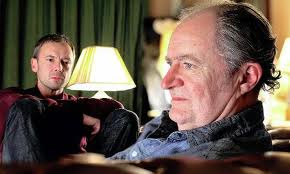
First up is the welcome reunion of the State of Play team of John Simm and writer Paul Abbott for Exile, a three-part serial showing this month. State of Play, remade in Hollywood, set a marker for the modern, political conspiracy thriller.
Exile stars Simm, who once again plays a journalist who ends up sleeping with his best-friend’s wife. But on this occasion he’s a washed-up lads’ mag writer who after 18 years in London returns to his Lancashire home, where his father, played by Jim Broadbent, is suffering from Alzheimer’s.
Forced to reassess his life, Simm pieces together a scandal that his father, a once formidable local paper investigative journalist, had sought to expose, which involves powerful figures in the local council figure and constabulary. Simm unwittingly reveals a devastating crime that tore the family apart before he left for London.
Written by Danny Brocklehurst (The Street), Exile was originally devised by Abbott as a low-budget feature film, set in Washington. Relocated to Oldham, the drama neatly captures the push-and-pull of returning home to a small town.
There’s a nicely-observed scene where Simm visits the local pub to find the locals staring in silence at Question Time, which has been left playing on the TV screen, which is itself on mute. “Why do people do that?” asks Simm’s character, Tom.
The scenes depicting Tom’s mixture of frustration with his father’s failure to remember, anger and tender concern are well-played with Broadbent, who picked up a role initially intended for Pete Postlethwaite. Alzheimer’s does appear a convenient plot device though, as shards of Broadbent’s memory fleetingly return, to reveal details of the conspiracy which goes to the top of local politics.
The tension builds nicely over three hours (would it have been a six-parter like State of Play five years ago?) and the serial will be screened over consecutive nights this month. If it’s not exactly an advert for voting in the May local government elections, neither is another BBC One drama, The Fuse, announced this week.
Here we find Daniel Demoys, a former idealistic young man, who has become a council politician and inevitably, a corrupt one. He stands for Mayor of Manchester on a populist ticket as the candidate who speaks his mind. But Demoys is an alcoholic who has, rightly or wrongly, killed a man. Like Exile, it’s set in the north west and produced by Nicola Shindler.
Bill Gallagher, writer and executive producer, says: “I liked the idea of starting a story with a man who finds himself in a self-induced hell, and following him as he tries to make amends for the harm he has done. He happens to be a politician, so he has a chance to pay for his sins in his community.”
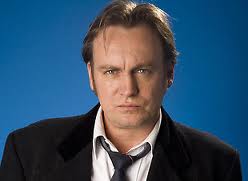
Is there a pattern emerging? How about the new four-part conspiracy thriller for BBC One starring Philip Glenister, Simm’s Life On Mars partner-in-crime fighting. In Undisclosed, written by Ronan Bennett, the former Gene Hunt plays a small-time solicitor, Harry Venn, forced to delve into his murky past.
As in Exile, this investigation unwittingly uncovers the truth about a devastating family scandal. And wouldn’t you know it, Harry quickly finds himself “caught up in a much bigger and more complex conspiracy that reaches deep into the heart of the British political system.”
These dramas uses politics as a backdrop to examine issues like redemption and family relationships. And it’s hard to find a Hollywood thriller that doesn’t lead somewhere to an out-of-control government agency.
But it’s instructive that UK politics at a local and national level seems to have become an instantly understood shorthand for greed, corruption, lies and even murder in television drama without anyone suggesting it’s a conspiracy theory too far.
That might worry our elected representatives. Perhaps Lord Patten, the former Conservative cabinet minister, now in charge of the BBC Trust, might order a more positive portrayal of his former colleagues, currently wallowing in the mire as TV’s whipping boys.

 John Simm Society Blog
Leave a comment